

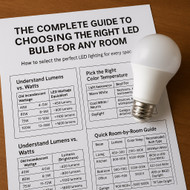
The Complete Guide to Choosing the Right LED Bulb for Any Room
How to Select the Perfect LED Lighting for Every Space
Finding the right LED bulb can make or break the look, feel, and function of a room. From cozy warm whites in a bedroom to bright daylight in a workspace, the right choice comes down to more than just wattage. This guide breaks down everything you need to know—lumens, color temperature, shape, and more—so you can pick the perfect LED for any setting.
Step 1: Understand Lumens vs. Watts
Watts measure how much energy a bulb uses, but with LEDs, lumens tell you how bright it will be.
| Old Incandescent Wattage | LED Wattage Equivalent | Lumens (Brightness) |
|---|---|---|
| 40W | 4–5W | ~450 lumens |
| 60W | 8–9W | ~800 lumens |
| 75W | 11–12W | ~1100 lumens |
| 100W | 15–16W | ~1600 lumens |
Tip: For reading lamps or task lighting, aim for 800+ lumens. For ambient living room lighting, 450–800 lumens is usually perfect.
Step 2: Pick the Right Color Temperature
Measured in Kelvins (K), color temperature affects mood and appearance.
| Color Temperature | Light Appearance | Best For |
|---|---|---|
| 2700K–3000K | Warm White | Bedrooms, living rooms, restaurants |
| 3500K–4100K | Cool White / Neutral | Kitchens, bathrooms, workspaces |
| 5000K–6500K | Daylight | Garages, basements, detailed work areas |
Tip: Warm light feels cozy, while daylight is energizing and great for focus.
Step 3: Match the Bulb Shape and Base
Common LED shapes:
-
A19 – Standard bulb for most fixtures.
-
BR30 – Recessed ceiling lights.
-
PAR38 – Outdoor floodlights.
-
G25 – Globe bulbs for vanities.
-
T8 – Tube lighting for offices or garages.
Tip: Always check your fixture’s base type—E26 (medium) and GU10 are common for household bulbs.
Step 4: Choose Dimmable or Non-Dimmable
If your fixture uses a dimmer, make sure your LED bulb is labeled dimmable and your dimmer switch is LED-compatible to avoid flicker.
Step 5: Consider Special Features
-
Smart LEDs – Control with your phone or voice assistant.
-
High CRI (>90) – Better color accuracy for art studios, kitchens, or retail.
-
Wet-Rated – Safe for bathrooms or outdoor areas.
Quick Room-by-Room Guide
| Room | Lumens | Color Temp | Recommended Bulb Type |
|---|---|---|---|
| Living Room | 450–800 | 2700–3000K | A19 Warm White |
| Kitchen | 800–1100 | 3500–4100K | BR30 or A19 Cool White |
| Bathroom | 800–1100 | 3500–4100K | G25 Cool White |
| Bedroom | 450–800 | 2700–3000K | A19 Warm White |
| Office | 800–1100 | 5000K | A19 or BR30 Daylight |
| Garage | 1100–1600+ | 5000–6500K | T8 Tube Daylight |
LED Bulb Buying FAQs
Quick answers to the most common questions when choosing LEDs for any room.
What’s the difference between lumens and watts?
What color temperature should I use in each room?
How bright should my bulb be?
Do I need a dimmable LED and a special dimmer?
What is CRI and when does it matter?
Are LEDs safe in enclosed fixtures or damp locations?
Which bulb shape and base should I pick?
Do smart LEDs replace a dimmer switch?
What’s the best LED for reading?
Can I use LED bulbs in enclosed fixtures?
Do LEDs save money?